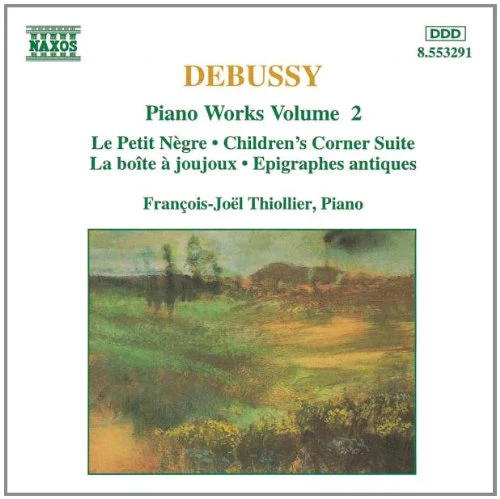
Thiollier - Debussy - Piano Works, Volume 2 [CD]
All items shipped within 3 working days of payment.
Please note that all our DVDs are Region 2.
Please note that not all audio CDs are shrink-wrapped fom the factory.
Claude Debussy (1862-1918)Piano Music, Vol. 2 Le petit negre (The Little Negro) (1909) Children's Corner (1906-08) La bo?\xabte ?\xe1 joujoux (1913) Six epigraphes antiques (1914)Claude Debussy was born in 1862, the son of a shop-keeper who was later to turn his hand to other activities, with varying success. He started piano lessons at the age of seven and continued two years later, improbably enough, with Verlaine's mother-in-law, who claimed to have been a pupil of Chopin. In 1872 he entered the Conservatoire, where he abandoned the plan of becoming a virtuoso pianist, turning his principal attention to composition. In 1880, at the age of eighteen, and in the following two summers, he was employed by Tchaikovsky's patroness Nadezhda von Meck as tutor to her children and house-musician. On his return to the Conservatoire from the first of these visits abroad, he entered the class of Bizet's friend Ernest Guiraud and in 1884 won the Prix de Rome, the following year reluctantly taking up obligatory residence, according to the terms of the prize, at the Villa Medici in Rome, where he met Liszt. By 1887 he was back in Paris, winning his first significant success in 1900 with Nocturnes for orchestra and going on, two years later, to a succes de scandale with his opera Pelleas et Melisande, based on the play by Maurice Maeterlinck, a work that established his position as a composer of importance. Debussy's personal life brought some unhappiness in his first marriage in 1899 to a mannequin, Lily Texier, after an intermittent liaison of some ten years with Gabrielle Dupont. His association from 1903 with Emma Bardac, the wife of a banker and an amateur singer, led to their eventual marriage in 1908. In the summer of 1904 he had abandoned his wife, moving into an apartment with Emma Bardac, and the subsequent attempt at suicide by his wife, who had shared with him the difficulties of his early career, alienated a number of the composer's friends. His final years were darkened by the war and by cancer, the cause of his death in March 1918, when he left unfinished a planned series of chamber music works, describing himself patriotically as musicien fran?\xbaais, only three of which had been completed.As a composer Debussy must be regarded as one of the most important and influential figures of the earlier twentieth century. His musical language suggested new paths to be further explored, while his poetic and sensitive use of the orchestra and of keyboard textures opened still more possibilities. His opera Pelleas et Melisande and his songs demonstrated a deep understanding of poetic language, revealed by his music, expressed in terms that never overstated or exaggerated. Le petit negre (The Little Negro), written in 1909, is in the mood of the earlier Golliwogg's Cake-Walk, included in Children's Corner. It appeared in Throdore Lack's Methode de piano. Children's Corner is a set of pieces publi
The Petit Negre
Children's Corner Suite: Doctor Gradus ad Parnassum
Children's Corner Suite: Jimbo's Lullaby
Children's Corner Suite: Serenade For A Doll
Children's Corner Suite: The Snow Is Dancing
Children's Corner Suite: The Little Shepherd
Children's Corner Suite: Golliwog's Cake-Walk
La bo\xef\xbf\xbdte a joujoux: Prelude
La bo\xef\xbf\xbdte a joujoux: 1er tableau
La bo\xef\xbf\xbdte a joujoux: 2eme tableau
La bo\xef\xbf\xbdte a joujoux: 3eme tableau - Epilogue
Epigraphes antiques: I. Pour invoquer Pan, dieu du vent d'\xef\xbf\xbdt\xef\xbf\xbd
Epigraphes antiques: II. Pour un tombeau sans nom
Epigraphes antiques: III. Pour que la nuit soit propice
Epigraphes antiques: IV. Pour la danseuse aux crotales
Epigraphes antiques: V. Pour l'Egyptienne
Epigraphes antiques: VI. Pour remercier la pluie au matin
Original: $28.20
-65%$28.20
$9.87Product Information
Product Information
Shipping & Returns
Shipping & Returns
Description
All items shipped within 3 working days of payment.
Please note that all our DVDs are Region 2.
Please note that not all audio CDs are shrink-wrapped fom the factory.
Claude Debussy (1862-1918)Piano Music, Vol. 2 Le petit negre (The Little Negro) (1909) Children's Corner (1906-08) La bo?\xabte ?\xe1 joujoux (1913) Six epigraphes antiques (1914)Claude Debussy was born in 1862, the son of a shop-keeper who was later to turn his hand to other activities, with varying success. He started piano lessons at the age of seven and continued two years later, improbably enough, with Verlaine's mother-in-law, who claimed to have been a pupil of Chopin. In 1872 he entered the Conservatoire, where he abandoned the plan of becoming a virtuoso pianist, turning his principal attention to composition. In 1880, at the age of eighteen, and in the following two summers, he was employed by Tchaikovsky's patroness Nadezhda von Meck as tutor to her children and house-musician. On his return to the Conservatoire from the first of these visits abroad, he entered the class of Bizet's friend Ernest Guiraud and in 1884 won the Prix de Rome, the following year reluctantly taking up obligatory residence, according to the terms of the prize, at the Villa Medici in Rome, where he met Liszt. By 1887 he was back in Paris, winning his first significant success in 1900 with Nocturnes for orchestra and going on, two years later, to a succes de scandale with his opera Pelleas et Melisande, based on the play by Maurice Maeterlinck, a work that established his position as a composer of importance. Debussy's personal life brought some unhappiness in his first marriage in 1899 to a mannequin, Lily Texier, after an intermittent liaison of some ten years with Gabrielle Dupont. His association from 1903 with Emma Bardac, the wife of a banker and an amateur singer, led to their eventual marriage in 1908. In the summer of 1904 he had abandoned his wife, moving into an apartment with Emma Bardac, and the subsequent attempt at suicide by his wife, who had shared with him the difficulties of his early career, alienated a number of the composer's friends. His final years were darkened by the war and by cancer, the cause of his death in March 1918, when he left unfinished a planned series of chamber music works, describing himself patriotically as musicien fran?\xbaais, only three of which had been completed.As a composer Debussy must be regarded as one of the most important and influential figures of the earlier twentieth century. His musical language suggested new paths to be further explored, while his poetic and sensitive use of the orchestra and of keyboard textures opened still more possibilities. His opera Pelleas et Melisande and his songs demonstrated a deep understanding of poetic language, revealed by his music, expressed in terms that never overstated or exaggerated. Le petit negre (The Little Negro), written in 1909, is in the mood of the earlier Golliwogg's Cake-Walk, included in Children's Corner. It appeared in Throdore Lack's Methode de piano. Children's Corner is a set of pieces publi
The Petit Negre
Children's Corner Suite: Doctor Gradus ad Parnassum
Children's Corner Suite: Jimbo's Lullaby
Children's Corner Suite: Serenade For A Doll
Children's Corner Suite: The Snow Is Dancing
Children's Corner Suite: The Little Shepherd
Children's Corner Suite: Golliwog's Cake-Walk
La bo\xef\xbf\xbdte a joujoux: Prelude
La bo\xef\xbf\xbdte a joujoux: 1er tableau
La bo\xef\xbf\xbdte a joujoux: 2eme tableau
La bo\xef\xbf\xbdte a joujoux: 3eme tableau - Epilogue
Epigraphes antiques: I. Pour invoquer Pan, dieu du vent d'\xef\xbf\xbdt\xef\xbf\xbd
Epigraphes antiques: II. Pour un tombeau sans nom
Epigraphes antiques: III. Pour que la nuit soit propice
Epigraphes antiques: IV. Pour la danseuse aux crotales
Epigraphes antiques: V. Pour l'Egyptienne
Epigraphes antiques: VI. Pour remercier la pluie au matin